GPS Tracker: Find My Family
- 4.3
- Rating
- 1.00M
- Installs
- Free
- Price
 Analysis by App-foxy
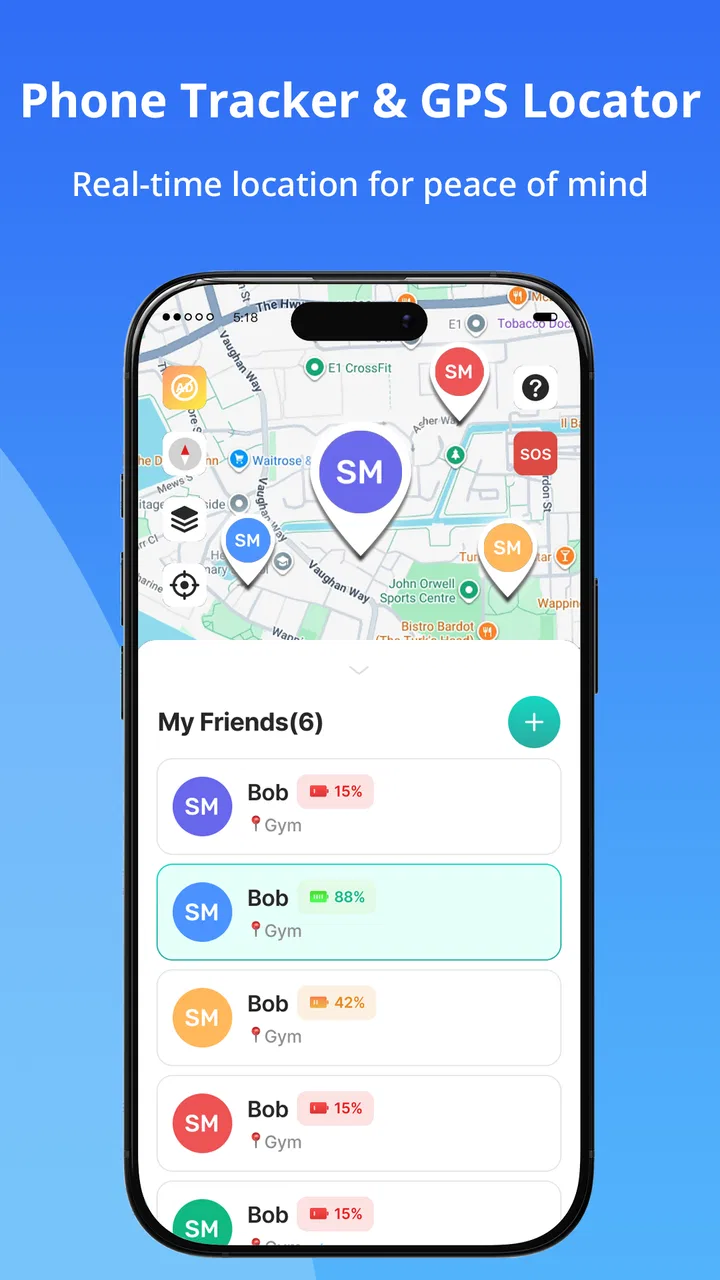
I approached GPS Tracker: Find My Family as a practical family-location tool rather than as a full replacement for the navigation apps already on my phone. Its purpose is straightforward: sharing locations, receiving alerts about places, and helping family members find a misplaced phone. That focus gives it a useful identity in the Maps & Navigation category, especially for people who want a simple way to stay connected without building a complicated travel plan.
The app is free to download, developed by Mitra MT, and available for Everyone. It has reached over a million installs and holds a 5.0 average from around 1.3 thousand ratings. Those figures suggest that the basic idea has found an audience, although I would not treat a high average alone as proof that it will suit every household. Location tools are highly personal: what feels reassuring to one family can feel intrusive or confusing to another.
How the app feels to use in everyday situations
I find that the app’s everyday value depends less on watching a moving map and more on agreeing what a location check should help you decide. Before relying on it, I’d talk through who will check in, which places matter, and when a direct call is still the better choice. That practical foundation makes it easier to judge whether its focused approach fits your household.
You May Also Like

 Blood Strike: 2.5 Anniversary
Blood Strike’s Loadouts Turn Every Drop Into a Tactical Gamble
A close look at Blood Strike’s custom loadouts: how fast access to signature weapons reshapes its battle royale rhythm, rewards preparation, and narrows the gap between fights.

 Pandora - Music & Podcasts
Pandora’s Music Is Easy to Start, but Harder to Recover
Pandora’s strength is its low-effort path from a seed to a station. Its weak spot is how much confidence it asks you to place in connection, setup, and quiet recovery.

 8 Ball Pool
 Is Built on Rivalries, Rematches, and Routine
A close look at the rivalries, rematches, shared routines, and unanswered safety questions that turn a quick pool match into a persistent mobile community.

 Samsung Music
’s Quiet Strength Is Playing What You Already Own
Its reach comes less from spectacle than from dependable access to a personal library. That simplicity is both the app’s strongest retention engine and its ceiling.

 AccuWeather: Weather Radar
AccuWeather Review: A Quick, Clear Forecast for Everyday Decisions
For everyday plans, the best forecast is the one you can understand quickly. AccuWeather makes rain timing, radar, and local conditions easy to act on, with a few trade-offs.

 Hill Climb Racing
Why Hill Climb Racing Still Turns Crashes Into One More Run
A tiny car, a bumpy hill and one more upgrade: Hill Climb Racing keeps resurfacing because its simple chaos makes every near-miss feel personal.
More From Our News Desk



Readability and navigation that favor a focused purpose
What I like most about the concept is that it does not try to be everything at once. When I open a family tracker, I am usually looking for one of a few answers: where a person is, whether someone has reached a familiar place, or how to recover a phone that has been misplaced. Keeping those tasks close to the center can make the experience easier to understand than a broad navigation service filled with route planning, business listings, traffic layers, and travel recommendations.
That narrow purpose also matters for people who find dense interfaces tiring. A person with low vision, attention difficulties, or limited experience with location apps may benefit from having fewer competing destinations on screen. I found it more useful to think of the app as a household check-in tool than as a map for exploring an unfamiliar city. That mental model makes the first decisions clearer: set up the family connection, decide which places matter, and use alerts only where they solve a real problem.
My practical advice is to establish the important locations before an urgent situation occurs. A home, school, workplace, care facility, or regular meeting point is more useful than creating alerts for every place a family member visits. Too many notifications can make the meaningful ones easy to overlook, particularly for someone who processes information slowly or becomes anxious when a phone produces frequent interruptions.
The app's current version is 1.0.4, and I would approach it as a focused tool that may still feel less mature than long-established mapping platforms. That is not automatically a weakness. A smaller feature set can reduce the learning burden, but it also means I would keep another mapping app available for detailed directions, public transport planning, or checking businesses and landmarks.
Motor and sensory considerations in real use
Location sharing sounds simple, but it can involve several actions at the wrong moment: opening the app, selecting a family member, checking a map, responding to an alert, or locating a phone while distracted. For users with tremors, reduced dexterity, or difficulty with precise taps, this kind of workflow is easiest when the setup is completed calmly and the number of choices is kept low. I would avoid designing a routine that depends on rapidly tapping through multiple screens during an emergency.
There is also a sensory side to tracking. Alerts can be reassuring, but they can become stressful if they arrive too often or at unexpected times. A family member who is sensitive to sound may prefer to rely on visual notification cues, while someone who does not regularly look at a screen may need a different household agreement. The app can support the location part of that arrangement, but the family still has to decide how alerts should be interpreted and who is responsible for checking them.
For someone with cognitive or memory-related challenges, the strongest use case is a predictable routine. For example, a caregiver might use a place alert around a regular destination rather than asking the person to remember to send a message every time. That reduces dependence on a manual check-in. The trade-off is that the family must understand what an alert means and what it does not mean. An alert can indicate a location event, but it should not replace a conversation about safety, consent, or what to do when a phone battery is low.
I also see a benefit for households supporting an older relative who is comfortable carrying a phone but not with complicated technology. The family can agree in advance on a small set of actions: keep the phone charged, carry it consistently, and contact a named person if something looks unusual. This is more realistic than expecting the person to explore every function. The best accessibility improvement here is often a simple shared routine, not a longer feature list.
Situational access: where it helps and where it does not
Consider a realistic afternoon. A parent is waiting for a child to finish an activity, another family member is traveling home, and someone cannot remember where they left a phone. In that situation, a family location app can reduce several separate messages. The parent can check the agreed location information, a place alert can provide a useful arrival signal, and the misplaced-phone function may help narrow the search. I would still use ordinary calling or messaging for direct communication, but the tracker can reduce the need to ask the same “Where are you?” question repeatedly.
This is especially useful for families who live or work on different schedules. It can help when a caregiver needs a quick status check without interrupting a meeting, or when relatives want a shared view of a planned arrival. The feature is not just about convenience; it can also reduce the communication load for people who find repeated phone calls difficult.
However, situational access depends heavily on the phone being present and usable. If the device is left at home, switched off, out of battery, or not carried by the person being tracked, the location information may not reflect the person's actual whereabouts. That limitation is easy to forget when an app feels reassuring. I would explain this clearly to every member of the household before relying on it for a vulnerable person.
The misplaced-phone purpose is another practical strength, but it should be viewed as a recovery aid rather than a guarantee. It is most helpful when the family has already agreed who can assist and when everyone knows how to start the search. If the phone was lost in a public place, stolen, or no longer connected, the app may not solve the larger safety problem. In those cases, contacting the relevant people and protecting accounts matters more than repeatedly checking a map.
For travel, I would use it as a companion to a conventional navigation app. A standard map service is usually the better choice for turn-by-turn directions, route alternatives, accessibility information about a destination, and public transit details. GPS Tracker: Find My Family is more relevant when the question is “Has my family member arrived?” rather than “Which route should I take?” That distinction prevents disappointment and helps each app do the job it handles best.
Privacy, consent, and the human side of location sharing
Any family tracker needs a clear agreement before it becomes part of daily life. I would not install it on someone else's phone and assume that family status automatically gives permission to monitor them. A useful setup begins with a conversation about who can see locations, when sharing is expected, and what happens if someone wants to pause it. This is particularly important for teenagers, adults with support needs, and relatives whose independence should be respected.
Location information can also create misunderstandings. A map point may look precise even when it represents a nearby area or a recent update. I would avoid treating a displayed position as proof that someone is safe, available, or doing something wrong. The healthiest arrangement is to use the app for agreed practical purposes, then contact the person directly when the situation requires context.
There is a financial detail worth keeping in mind. The app is free, but in-app purchases range from $2.99 to $9.99 per item. That does not automatically make it poor value, yet I would review any purchase screen carefully before adding it to a family routine. A household should decide whether the free experience already covers its needs and whether optional spending provides a meaningful improvement rather than simply adding pressure to subscribe or upgrade.
The age rating is Everyone, which makes the app broadly approachable in terms of its listed audience. Still, an Everyone rating is not a substitute for a family discussion about privacy and consent. Younger users may need an adult to explain what location sharing means, while older users may need help distinguishing an alert from an emergency notification. Inclusive use depends on that explanation as much as on the interface itself.
Remaining barriers and the situations where I would skip it
My main reservation is that location tracking can appear simpler than it really is. The visible map is only one part of the system. The household must keep phones charged, maintain agreed sharing habits, understand alerts, and know how to respond when information looks unexpected. For a family that does not want this ongoing responsibility, the app may create more worry than reassurance.
I would also skip it as a primary tool for professional care, emergency response, or high-risk personal safety. Those situations need dependable procedures, direct communication, and services designed for that level of responsibility. A consumer family tracker can support a care plan, but it should not become the only safeguard for someone who may wander, become medically unwell, or be unable to explain their situation.
Another barrier is the possibility of notification fatigue. A well-meaning family can create too many place alerts and then begin ignoring them. I recommend starting with one or two genuinely important locations, observing whether the alerts are useful, and expanding only if the household can explain why each new alert is needed. This is a small but important workflow improvement that is easy to miss when first setting up a tracker.
People who need detailed accessibility information about routes may also prefer a conventional navigation service. This app's value is centered on family location awareness, not on giving a complete picture of curb cuts, entrances, transit elevators, road conditions, or indoor navigation. If those details determine whether a journey is possible, I would use a specialized source alongside it rather than expecting the tracker to answer those questions.
There is also a social barrier for families with different comfort levels around monitoring. One person may see location sharing as helpful, while another may experience it as pressure. In that case, the right solution may be a limited schedule, a single arrival alert, or ordinary messaging instead of continuous sharing. If the family cannot agree on boundaries, I would not force the app into the routine simply because it is free to install.
My inclusive verdict after using it as a family tool
I see GPS Tracker: Find My Family as a sensible option for households that want a focused way to share locations, receive place-related alerts, and look for a misplaced phone. Its strongest quality is its practical scope. It can reduce repeated check-in messages and make a familiar routine easier for people who struggle with remembering manual updates. The app is also approachable for families that do not need a large navigation platform for this particular task.
My recommendation comes with conditions. Set it up together, keep the number of alerts small, explain what location information can and cannot prove, and maintain another way to contact each person. Those steps make the experience more inclusive for users with visual, motor, sensory, or cognitive differences because they reduce rushed actions and unclear expectations.
I would recommend it to families, caregivers, and relatives who want a straightforward location-sharing arrangement and are comfortable discussing consent. I would not recommend relying on it alone for emergencies, complex travel, or situations where professional-grade reliability is essential. In those cases, a standard navigation app, direct communication, or a dedicated safety service may be the better choice.
Overall, my opinion is positive but measured. Mitra MT has positioned this free Maps & Navigation app around a real everyday need, and the large install base shows that the idea is easy for people to understand. Its value comes less from replacing every other tool and more from quietly supporting a shared family routine. If that is exactly what you need, it is worth trying; if you are looking for detailed route planning or a complete care system, I would choose something more specialized.
FAQs for GPS Tracker: Find My Family
01Is the GPS Tracker: Find My Family app safe to use?
Yes, the GPS Tracker: Find My Family app is designed with user safety and privacy in mind. It uses encrypted data transmission to ensure your location information is secure. However, it’s important to only share your location with trusted individuals and to regularly review the app’s privacy settings.
02Does the app work on both Android and iOS devices?
Absolutely. GPS Tracker: Find My Family is available on both Android and iOS platforms. This allows for seamless tracking across different device types, ensuring you can stay connected with family members regardless of the smartphone they use.
03How accurate is the location tracking in the app?
The GPS Tracker app provides highly accurate real-time location tracking using advanced GPS technology. However, accuracy can vary depending on factors such as signal strength, geographical location, and device settings. It’s best used in areas with strong GPS reception for optimal performance.
04What features does the app offer besides location tracking?
Beyond real-time location tracking, the app includes features like geofencing alerts, location history, and emergency SOS signals. These tools are designed to enhance family safety by notifying users of arrivals and departures and providing a record of past locations.
05Is there a cost associated with using the app?
The GPS Tracker: Find My Family app offers a free version with basic features. However, for access to premium features like extended location history and custom geofencing options, a subscription is required. Pricing details can be found on the app’s download page or within the app itself.
Pros
- Real-time location updates are accurate.
- Easy-to-use interface for all ages.
- Battery-friendly operation saves power.
- Customizable alerts for specific zones.
- Comprehensive family safety features.
Cons
- Requires constant internet connection.
- Limited features in free version.
- May drain battery on older devices.
- Occasional location inaccuracies.
- Privacy concerns with data sharing.

GPS Tracker: Find My Family
Gallery